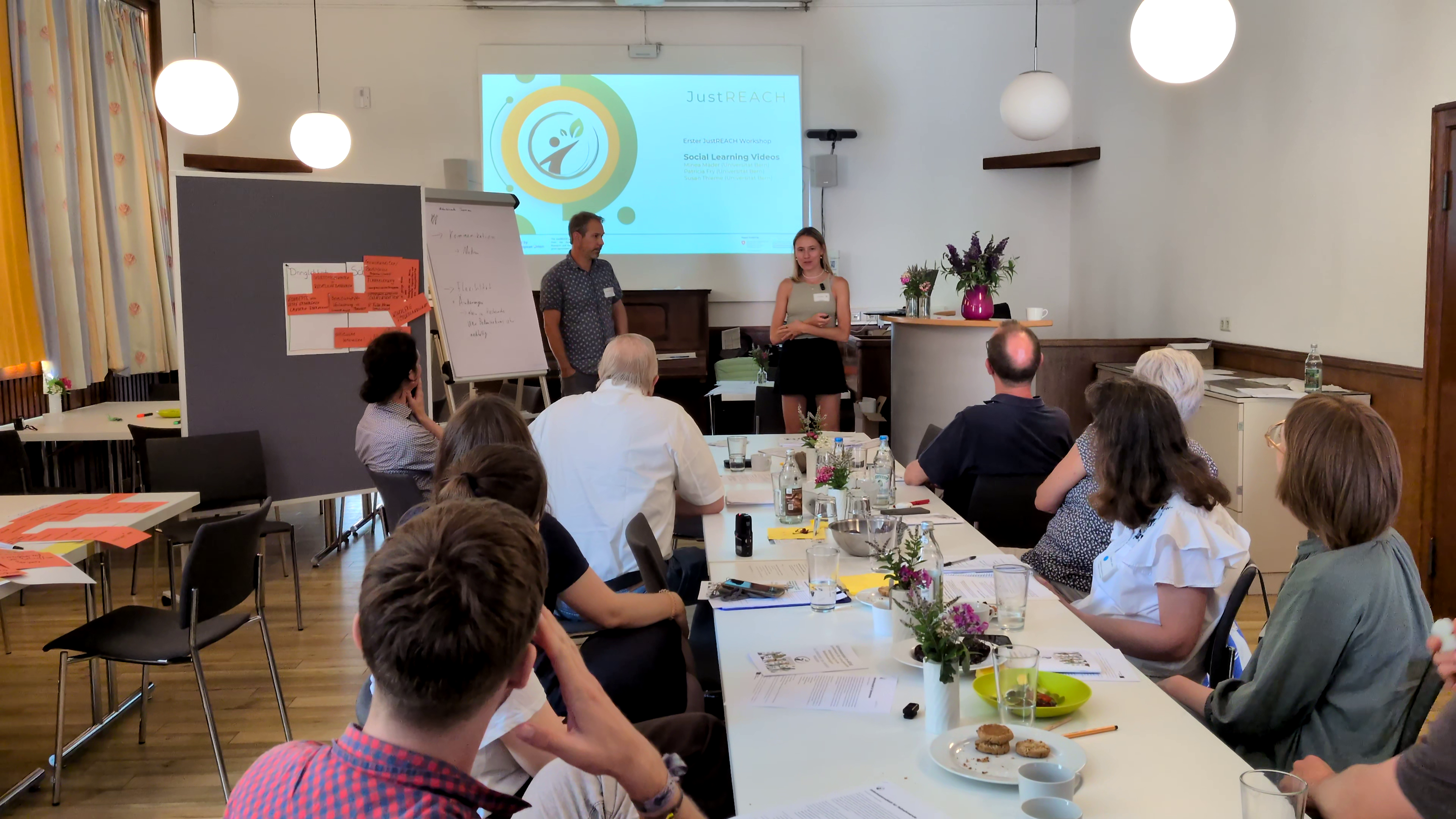
Equitable climate adaptation requires many stakeholders. Last month in Germany, JustREACH project partners from the Lake Constance Foundation, in collaboration with Joanneum Research in Graz and the University of Bern, organized the project's first participatory workshop.
Held at the "Mehrgenerationenhaus" in Radolfzell, the workshop brought together representatives from social services, government, and the cultural sector across the Constance district.
The heat wave in June is still fresh in our minds. But rising temperatures are just one consequence of climate change. Other extreme events, such as heavy rain and hail, will affect us more frequently in the future. Certain groups of people are particularly vulnerable. For example, those who cannot afford air conditioning or home renovations, those who are elderly or ill, and those without a yard are left with few options for adapting.
How can climate change adaptation be designed in a socially equitable way? This question is at the heart of JustREACH project, in which the Lake Constance Foundation is managing a pilot region in collaboration with the Constance district. As part of the project, the first participatory workshop took place at the “Mehrgenerationenhaus” in Radolfzell. The focus was on discussion and a multi-perspective assessment of climate change adaptation in the Constance district.
Working in small groups, participants created so-called “rich pictures” to identify and visually document the consequences of climate change, affected groups, and known measures. Among the affected groups, participants included children, people with health conditions, older adults, as well as farmers and freelance artists. In terms of measures, they listed not only tools such as soil restoration, tree planting, and technical solutions, but also community-based cool spaces as an option.
In a subsequent step, barriers that hinder successful adaptation were identified and categorized. The group work revealed that the perspectives of the stakeholders often overlap, yet significant differences exist in certain areas—for example, in their perception of the obstacles and the difficulty of overcoming them. At the same time, it became clear across all groups that the discrepancy between knowledge and action often remains a major obstacle.
The entire workshop was marked by lively discussions among the participants. The mix of stakeholders proved to be an asset to the discussions. “Recognizing the diverse perspectives on climate adaptation and integrating them into this complex topic is a major challenge. At the same time, however, this is precisely what is crucial to bringing about an active shift in thinking across society at large. The workshop has laid the groundwork here for addressing future challenges in the district on a broad, socially just basis” said Antje Reich, project manager at the Lake Constance Foundation, commenting on the workshop. Participants shared experiences from their personal daily lives as well as from various professional fields, including climate managers from municipalities and representatives from the district’s Office for Children, Youth, and Families. Also represented were nature conservation organizations, social services, municipal utilities, the Senior Citizens’ Council, and cultural institutions.
Workshop participants received a booklet. It is available for download here.
Looking ahead, the event concluded with a preview of upcoming "Social Learning Videos". These short films, produced locally as part of the project, will showcase practical examples of climate adaptation achieved through collaboration.
This workshop marks the first in a broader series. The next event is scheduled for spring 2027, where partners will build on these insights to develop implementation strategies for concrete, equitable measures.